
Services Details
Get An Appointment


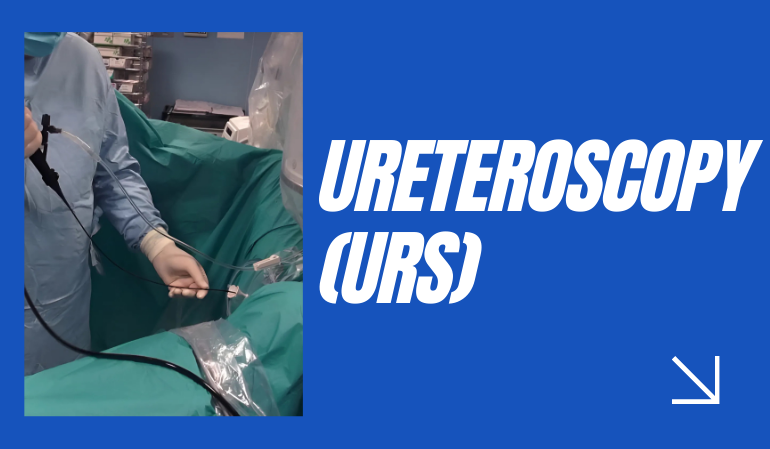
Ureteroscopy (URS)
Ureteroscopy (URS) is a minimally invasive procedure used to diagnose and treat problems in the urinary tract, especially kidney and ureteric stones. A thin, flexible instrument called a ureteroscope is passed through the urinary passage to directly visualize and treat stones, blockages, or tumors.
With over 20 years of expertise in Endo-Urology, Robotic & Laparoscopic Surgery, and Stone Management, Dr. Sachin Kathuria is highly experienced in performing URS procedures with excellent outcomes. Practicing at Sir Ganga Ram Hospital, New Delhi, he is regarded as the best urologist in Old Rajinder Nagar for advanced stone removal techniques.
When is Ureteroscopy Needed?
URS is recommended for patients who have:
● Stones in the ureter or kidney that cannot pass naturally
● Stones that are too large or stuck
● Recurrent urinary tract infections due to stones
● Narrowing (stricture) or blockage in the urinary tract
● Suspicion of tumors in the ureter or kidney
Types of Ureteroscopy
● Rigid URS: Used for stones in the lower ureter
● Flexible URS: Used for stones in the upper ureter or kidney, allowing greater reach
Treatment Process
1. A ureteroscope is gently inserted through the urinary passage.
2. The stone is visualized with a high-definition camera.
3. Laser technology (Holmium laser lithotripsy) is used to break the stone into small fragments.
4. Fragments are either removed or allowed to pass naturally.
5. A temporary stent may be placed to ensure smooth urine flow.
Advantages of URS
● Minimally invasive, no cuts or stitches
● High success rate for ureteric and kidney stones
● Short hospital stay, often discharged within 24 hours
● Faster recovery and return to normal activities
● Can treat stones resistant to shockwave therapy (ESWL)
Why Choose Dr. Sachin Kathuria for URS?
● Over two decades of experience in laser and endoscopic stone removal
● Expertise in rigid and flexible ureteroscopy
● Performs URS with advanced equipment at Sir Ganga Ram Hospital
● High patient satisfaction and success rates
● Trusted as the best urologist in Old Rajinder Nagar for minimally invasive stone surgery
Frequently Asked Questions (FAQs)
Q1. Is ureteroscopy painful?
No. URS is done under anesthesia, and patients generally experience only mild discomfort afterward.
Q2. How long is recovery after URS?
Most patients can resume normal activities within 2–3 days.
Q3. Is URS safe for large stones?
Yes, URS with laser lithotripsy is very effective for large or impacted stones.
Q4. Will I need a stent after URS?
In some cases, a temporary stent is placed to help urine flow and prevent blockage.
